

The Signal and the Noise: Reviewing Our 2026 Polymarket Challenge
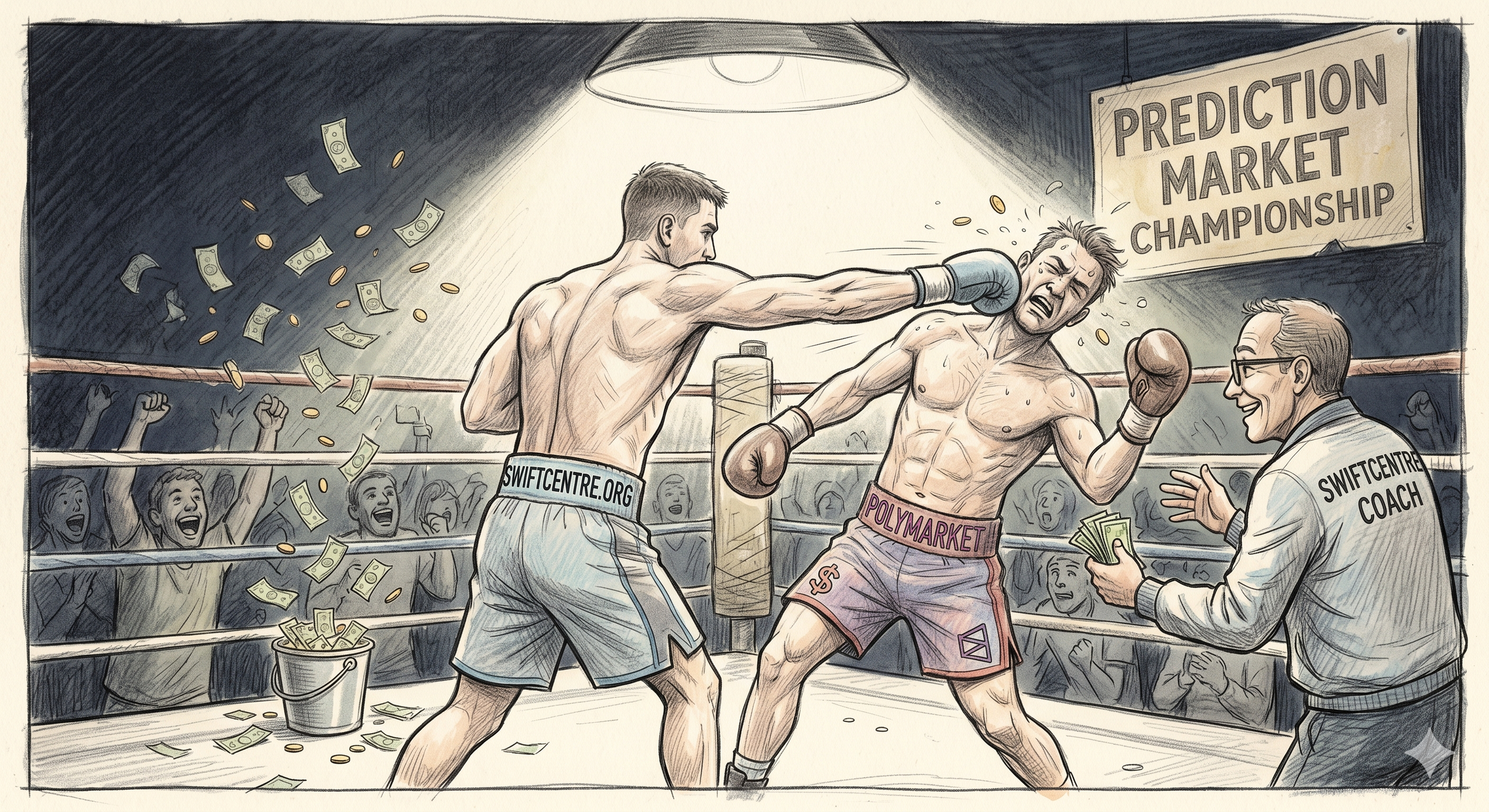
In late January 2026, the Swift Centre identified several key geopolitical markets on Polymarket that appeared fundamentally mispriced, often distorted by headline-driven hype. To put our credibility to the test, we pitted our expert forecasters against these markets in a high-stakes comparative analysis.
The results were definitive: a hypothetical $400,000 portfolio targeting these mispricings would have yielded a 32% return (+$127,148) in just over three months. From not over-updating on the Trump-Greenland hype to anticipating the February US strikes on Iran, our team provided a clear signal through the noise, proving that specialised expertise remains the ultimate hedge against market volatility.
1. Will the USA acquire Greenland in 2026?
Swift Centre Forecast: 4%
Polymarket at the time: 12%
Polymarket now (May 1): 2%
If we bet $100,000 on NO thenand sold now: +$11,360 GAIN
Brief reflection: Polymarket traders over-indexed on Trump’s "deal-making" persona. Swift Centre correctly identified that NATO stability and Danish sovereignty provided a larger blocker than the market believed.
2. Russia-Ukraine ceasefire in 2026?
Swift Centre Forecast: 22%
Polymarket at the time: 43%
Polymarket now (May 1): 29%
If we bet $100,000 on NO then and sold now: +$24,560 GAIN
Brief reflection: The Trump peace deal hype inflated this price to nearly 50/50. Swift Centre experts relied on historical baselines of conflicts and on the trajectory of the war in Ukraine.
3. Will the USA take control of the Panama Canal in 2026?
Swift Centre Forecast: 6.7%
Polymarket at the time: 15%
Polymarket now (May 1): 7%
If we bet $100,000 on NO then and sold now: +$9,410 GAIN
Brief reflection: This suffered from the similar narrative as the Greenland hype. Once the administration’s focus shifted entirely toward the Middle East in February, the Panama land-grab theory evaporated.
4. Khamenei out as Supreme Leader by March 31?
Swift Centre Forecast: 27%
Polymarket at the time: 26%
Action: NO BET (Price was efficient)
Reflection on Resolution: Even though this resolved YES (after the Feb 28 strikes), it was riddled with issues because of the massive insider trading scandal and the political backlash on polymarket given the killing of Khamenei during the initial US strikes on Iran. New accounts flooded Polymarket just hours before the strikes, causing the price to jump to 93% in minutes. While the Swift Centre's 27% was closer to the eventual truth than the early market, the lack of a clear spread in January means it wouldn’t have been worth trading on at the time.
5. US military strike on Iran by March 31, 2026?
Swift Centre Forecast: 68%
Polymarket at the time: 55%
Polymarket now: 100% (Resolved YES)
If we bet $100,000 on YES then and sold now: +$81,818 GAIN
Brief reflection: This was the major arbitrage. While the public was skeptical that Trump would actually start a war, the Swift Centre’s 13% lead over the market was a strong and accurate signal. Our focus on political interest in the Trump administration, logistics, and the military build-up paid off massively.
Lightning Strikes Twice: Our Round 2 Forecasts
The scientific method demands repeated evidence. Not ones to shy away from scrutiny, the Swift Centre has once again looked deep into the Polymarket crystal ball and found it to be wanting across the board.
We selected five active markets we feel are currently inaccurate. On April 27th, we provided our own assessments of what our world-leading team thinks are the true probabilities. Here is where the crowd is getting it wrong today.
1. US and Iran agree to a permanent peace deal by 31st May 2026?
Swift Centre Forecast (on 27th April): 6.5%
Polymarket on same date: 30%
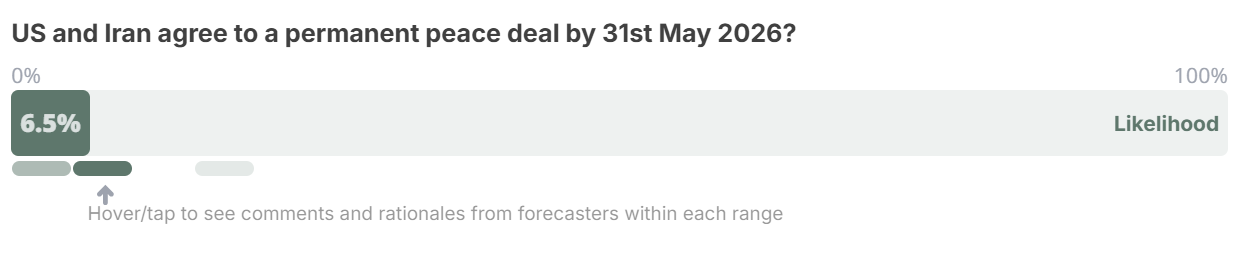
Forecasters viewed a finalised, permanent peace deal by May 31 as highly improbable. While a ceasefire might hold, negotiating the fine details of a permanent treaty historically takes months or years, meaning this could only resolve positively if Iran agreed to an immediate, unconditional surrender.
Arguments for a positive resolution: Trump strongly wants to end the conflict and is willing to make sacrifices to spin an agreement as a victory; an overwhelming US ground operation could hypothetically force a rapid capitulation.
Arguments against a positive resolution: Both sides remain incredibly far apart on maximalist demands (nuclear enrichment, ballistic missiles, the Strait of Hormuz); formal treaties take immense time to negotiate (the JCPOA took 18 months); Iran is incentivized to wait it out and endure rather than unconditionally surrender.
2. US obtains Iranian enriched uranium by May 31?
Swift Centre Forecast (on 27th April): 2%
Polymarket on same date: 9%

Polymarket traders have over-indexed on the possibility of a rapid extraction. Swift Centre forecasters noted that even with an immediate diplomatic breakthrough, physically removing the material within six weeks would be a logistical nightmare.
Arguments for a positive resolution: US and Israeli special forces have repeatedly pulled off highly complex, surprising tactical operations over the past two years; some uranium might be stored in more accessible locations.
Arguments against a positive resolution: It would be one of the most complex nuclear removal operations in history; much of the stockpile is believed to be buried deep under rubble at Isfahan or Fordow; logistical and security preparation alone would take weeks, even with a cooperative host.
3. Trump out as President before 2027?
Swift Centre Forecast (on 27th April): 4.6%
Polymarket on same date: 17%

The market heavily overestimates the likelihood of a political removal. Swift Centre forecasters calculated the baseline actuarial risk of death or incapacitation, deeming it the only realistic path for him to leave office early, effectively ignoring the noise around impeachment.
Arguments for a positive resolution: Actuarial tables indicate an approximate 3-5% chance of natural death or severe health incapacitation (such as a major stroke) for a man of his age; there is a lingering, albeit small, risk of assassination.
Arguments against a positive resolution: Invoking the 25th Amendment or successful impeachment is deemed highly unlikely (<1%), as the GOP and his Cabinet prefer to manage him to achieve their own policy goals (like Project 2025); Trump’s personality strongly precludes any chance of a voluntary resignation.
4. US strike on Cuba by December 31st 2026?
Swift Centre Forecast (on 27th April): 13%
Polymarket on same date: 37%

Swift Centre forecasters believed Polymarket was severely overreacting to political rhetoric. Unlike the actions in Venezuela or Iran, the team saw no justifying narrative or high-value military targets in Cuba that would warrant a kinetic strike.
Arguments for a positive resolution: The inherent unpredictability of the Trump administration; the possibility of seeking a PR win to please the domestic base (specifically in Miami) ahead of the midterm elections.
Arguments against a positive resolution: Open kinetic action against a collapsing state with a failing power grid would yield terrible PR with zero strategic upside; Cuba lacks military installations worth striking; the US administration is already heavily distracted by the aftermath of the Iran conflict.
5. Keir Starmer out by 30th June 2026?
Swift Centre Forecast (on 27th April): 28%
Polymarket on same date: 41%

The market was pricing in an emotional response to Starmer's "perfect storm" of dismal polling and political scandal. However, Swift Centre forecasters relied on structural base rates, noting the incredibly high threshold required to actually remove a sitting Labour PM who commands a massive parliamentary majority.
Arguments for a positive resolution: The brewing scandal over Peter Mandelson's security vetting; expected disastrous results in the May local elections; deep unpopularity with the general public ever since controversial cuts to pensioner benefits.
Arguments against a positive resolution: Labour lacks a clear, universally acceptable successor; Cabinet members are terrified that a more left-wing replacement could crash the bond markets (similar to Liz Truss's disastrous tenure); the rules to challenge a Labour leader are stringent, and Starmer is viewed as too stubborn to resign voluntarily