

Analysis produced by Alex Smith and Lisa Murillo
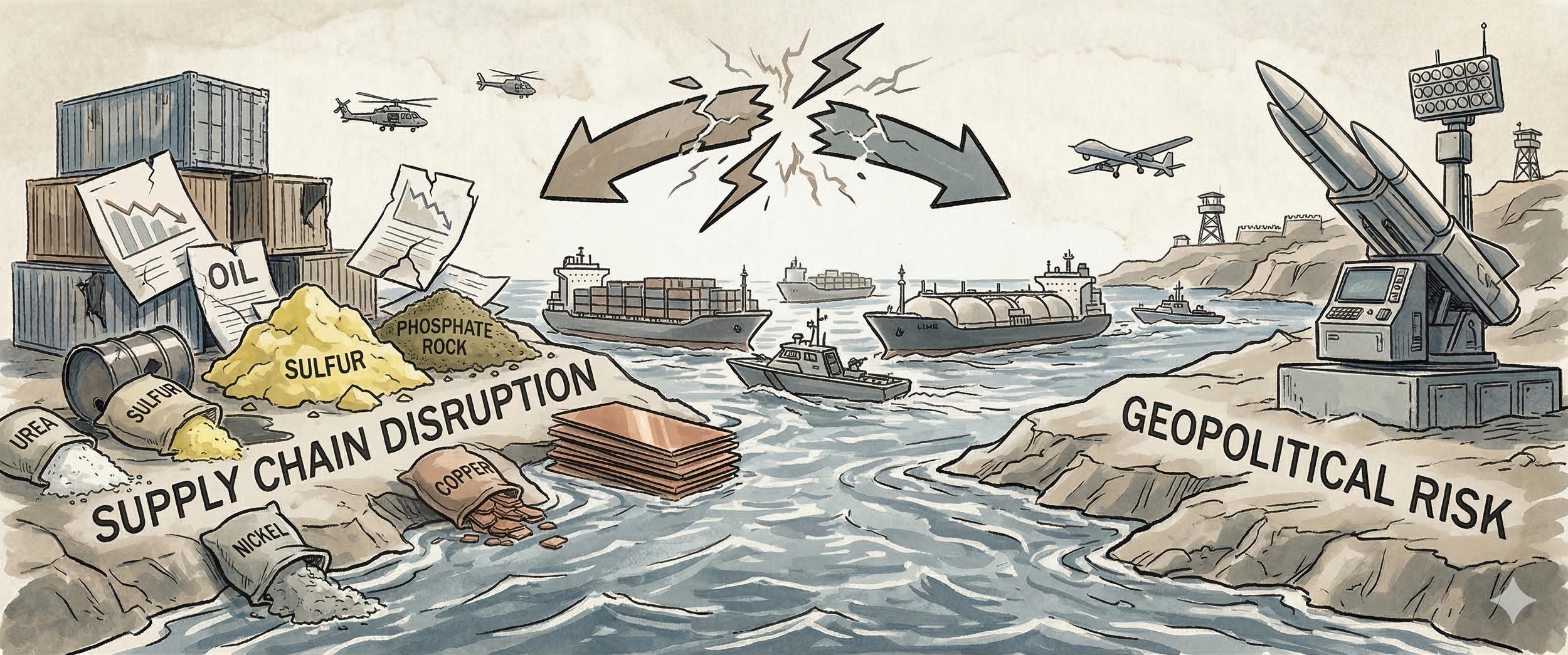
Shipping traffic through the Strait of Hormuz has nearly ceased since Israel and the U.S. first launched attacks on Iran on February 28. We will first provide an overview of the current situation, followed by a discussion of several current and potential consequences of the strait’s closure. Finally, we discuss the pros and cons of several potential solutions.
Current Situation
Shipping through the Strait of Hormuz has fallen because of Iranian threats, Iranian attacks on vessels, and rising maritime insurance rates for war risks. Iran has so far attacked between 10 and 17 vessels in the strait since March 1; there do not appear to have been any attacks since March 7. War-risk coverage has increased by over 1,000% in some cases, and some insurers are reducing or cancelling coverage.
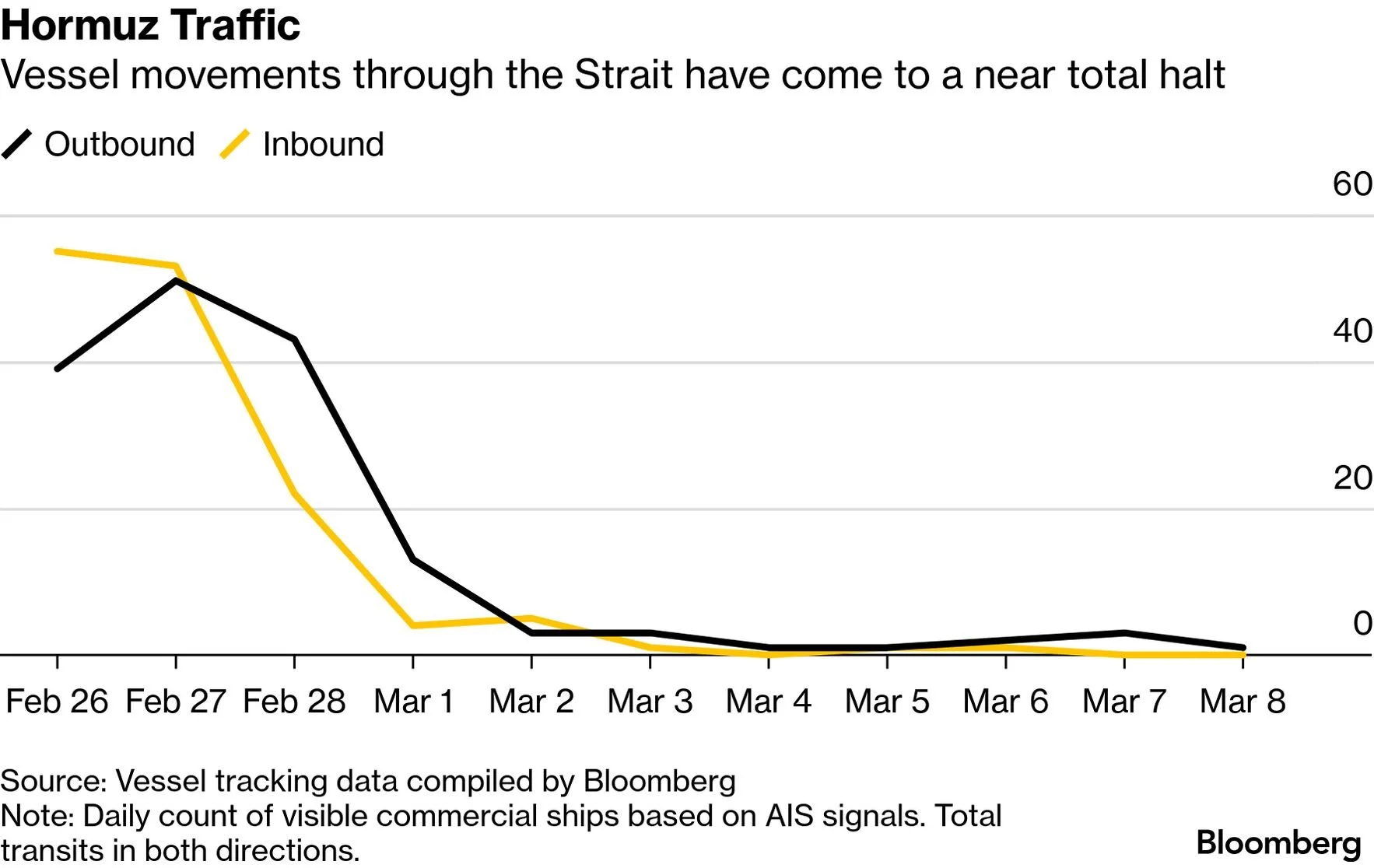
There is no clear end in sight to the de facto closure of the strait. However, ships appear to have started to transit the strait with their AIS transponders off. While the number of ships going through appears to be small, this development bears watching, as it holds the potential to allow more ships to travel through the strait.
In the meantime, the U.S. is focusing on reducing Iran’s capacity to launch missiles and drones at ships, “to reduce their ability to disrupt traffic.” U.S. President Trump and Energy Secretary Wright have both also said that the U.S. Navy might escort tankers through the strait. The U.S. will also offer maritime reinsurance up to $20 billion.
While the Trump administration has made optimistic comments suggesting that the strait may soon open up, other comments suggest that shipping traffic through the strait could be low for weeks. While U.S. Secretary of Energy Chris Wright said on March 8 that:
“We’re not too long, I think, before you will see more regular resumption of ship traffic through the Strait of Hormuz”
He also stated that in the “worst case” scenario, it could take “a few weeks” for vessel traffic to return to normal levels. That evening, U.S. President Trump posted on Truth Social that:
“Short term oil prices... will drop rapidly when the destruction of the Iran nuclear threat is over.”
That goal could take some time to accomplish. On March 9, although Trump said that the war is “very complete,” he also said the U.S. "could do a lot" about the strait and threatened further harm to Iran if the country were to act against shipping in the strait – and said he is "thinking about taking it over."
Consequences of Closure
Closing the Strait of Hormuz matters because about 20% of the world’s crude oil and liquefied natural gas (LNG) is shipped through the strait, as are substantial quantities of other commodities important for fertilizer, metals, and plastics markets. Choking supplies of all of these commodities could have profound effects on the global economy.
Rising crude oil and natural gas prices; largest oil supply disruption in history
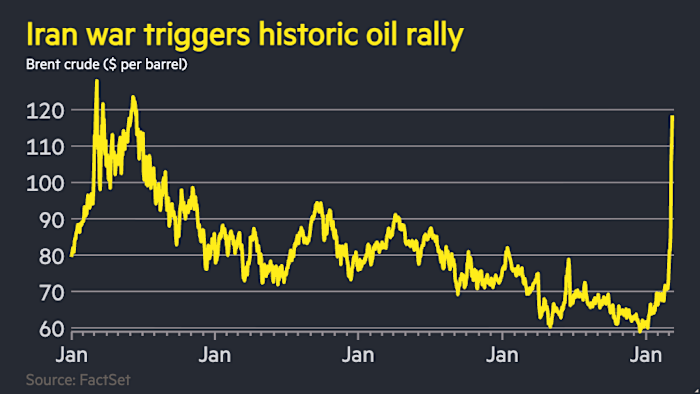
The current closure has caused the largest oil supply disruption in history. With the sudden disappearance of oil and natural gas shipments through the strait, oil and gas prices can skyrocket because markets don’t have time to adapt.
The price of oil surged to nearly $120 per barrel early Monday March 9, before the market pulled back to the mid-80s following an announcement that the G7 finance ministers met to consider a coordinated release of oil from their strategic reserves. The G7 energy ministers will meet on Tuesday morning to discuss the idea further.
Compounding the near-cessation of oil and LNG shipments, Iraq, Kuwait and the UAE are also scaling back crude oil production, as their storage facilities are filling. Iraqi production has fallen by 70% to 1.3 million bpd, from around 4.3 million bpd before the war. Iraqi crude storage facilities are completely full, and the remaining output will be used to supply Iraqi refineries. Qatar closed its LNG export plant, the world’s largest, after it was struck by an Iranian drone soon after hostilities started; the plant produces about one fifth of the global LNG supply.
Iranian strikes have damaged refineries in Bahrain, Kuwait, Qatar, Saudi Arabia and the UAE, as well as Qatar's LNG export facility. Following Israel’s attacks on Iranian energy infrastructure over the weekend, Iran is threatening to target energy infrastructure in Gulf states in earnest. Such an escalation would run the risk of causing damage that could reduce oil and gas output in the longer term. However, attacks during the past few days have declined significantly, indicating that strikes may have significantly diminished Iran’s ability to launch such attacks.
The U.S. Treasury Department is allowing India to buy crude oil from Russia for a month without violating sanctions, to ease that country’s supply crunch. While China has a large stockpile of crude oil, other Asian countries will be much harder hit by the strait’s closure.
Risks of inflation and global recession
If the strait’s closure lasts for weeks or longer, we could see extreme oil and LNG price shocks that run the risk of triggering a global recession. As oil and natural gas prices rise, so do the costs of everything produced using them as inputs, including electricity, gasoline, diesel, jet fuel, manufactured goods and food. While the prices of crude oil and natural gas are rising immediately, prices of many downstream goods won’t be felt until later but could be felt for up to even a year and a half or longer, for products that have longer production cycles. The current oil and gas price shocks, if prolonged, could result in substantial producer and consumer inflation that could dampen economic growth worldwide. Daniel Yergin, a prominent energy historian, said:
“We are looking at what is by far the biggest disruption in world history in terms of daily oil production…. If it goes on for weeks, it will reverberate across the global economy.”
Disruptions to the transportation industry
Increasing jet fuel prices would hurt the airline industry. Air cargo shipments are also already being affected, particularly between countries in Asia, Europe and the Middle East. Rising diesel prices would hurt the trucking industry, especially smaller businesses that cannot buy diesel at wholesale prices. Freight rail is nearly all powered by diesel-electric locomotives in the U.S., but diesel powers less than 20% of freight rail in Europe, which would be less directly affected. The inability to move cargo ships through the Strait of Hormuz may soon start to cause mild congestion at ports in India and may lead to ports being backed up in China. Each year, 2% to 3% of global container volumes pass through the strait.
Disruptions to fertilizer markets
Urea is the most widely used solid nitrogen fertilizer in the world, and together, Iran, Saudi Arabia, Qatar, the UAE and Bahrain produce more than one third of the world’s urea exports. These countries also account for nearly a quarter of the world’s ammonia exports, and one fifth of phosphate fertilizers.
Sulfur that passes through the strait is also used in the production of phosphate fertilizers, particularly in Morocco and China; sulfuric acid is used to convert insoluble phosphate in phosphate rock into soluble, plant-available forms. More than half of China’s sulfur imports come from the Middle East, and Chinese inventories could be rapidly depleted during the spring planting season.
LNG is also a key feedstock for nitrogen fertilizers. Global shortages of these key chemicals on which modern farming practices depend are already resulting in higher fertilizer prices that will affect the spring planting season in the Northern Hemisphere, which runs from March through June, and continued closure of the strait will likely result in lower crop yields, less food production, and higher food prices worldwide.
Disruptions to metals markets
The production of nickel, copper and cobalt will also be affected.
About one fourth of global sulfur production, or about half of the world’s sulfur exports, passes through the Strait of Hormuz. Ore refiners use sulfuric acid to leach nickel, copper and cobalt from ores; these metals are used in electric-vehicle batteries, electrical grids, electronics, and stainless steel.
More than half of the world’s nickel supply is produced in Indonesia, which imports about three quarters of its sulfur from the Middle East. Nickel plants typically have around a one to two months’ supply of sulfur on hand, and plants could be forced to slow or stop production as early as next month if the strait closure continues. Copper and cobalt producers in Africa will also be hard hit; copper production could be affected within weeks.
The market for refined aluminum will also be affected. Europe has become a major buyer of Middle Eastern aluminum, as it has tried to reduce its dependence on aluminum from Russia, and a large portion of Middle Eastern aluminum is exported through the strait.
Disruptions to plastics markets
Gulf exports of polethylene, methanol and ethylene glycol, a precursor chemical for several plastics, are also affected by the strait closure. Also, as oil prices rise, crude oil-dependent plastic production in Europe and Asia would suffer, whereas natural gas-dependent production in the U.S. would benefit from abundant domestic supplies of natural gas.
What Can Be Done? Pros and Cons
Multiple strategies could be employed to ease global supply crunches caused by closure of the Strait of Hormuz. Here, we consider diplomatic, military and financial options, and two direct ways to reduce oil and natural gas supply crunches.
Open the strait by diplomatic means
The most obvious means of re-opening the strait would be for the U.S. to engage in diplomacy with members of the Iranian leadership.
Part of this would be continued efforts to encourage assumption of control by more compliant leaders. Such efforts could then lead to a ceasefire, which would provide a reasonable level of assurance that no ships transiting the strait would be attacked. Assuming a credible Iranian central authority could be identified, this could be one of the fastest methods for resolving this crisis, with the least expenditure of resources. However, Israel, in particular, would likely be concerned about the possibility of the U.S. accepting unsatisfying conditions that allow threats to Israeli national security to persist.
Nevertheless, because of ongoing assassinations of Iranian leaders, it is inherently difficult to determine who could credibly negotiate on Iran’s behalf. Further, the recent U.S. demand for unconditional surrender makes it significantly more difficult for Iran to agree to diplomatic engagement. Therefore, this solution cannot be relied upon to resolve the effective closure of the strait.
Release oil and natural gas from countries’ strategic reserves to ease shortages
An immediate action that all countries could take is to begin drawing from their strategic petroleum and natural gas reserves.
Such actions would tend to cushion price increases and would certainly alleviate any supply shortages. However, releasing oil from strategic reserves could only alleviate oil shortages for at most 65-90 days for most countries. And some countries have far smaller reserves, meaning that they would exhaust their oil reserves much sooner.
Further, natural gas reserves are in far shorter supply, and some countries have none at all. And then there are other resources that regularly transit the strait for which there are negligible world reserves, such as fertilizers, including urea.
Fertilizers are of particular concern because many countries are now entering the growing season. So, although a shortage of oil can be mitigated for a few months, shortages of several other commodities, especially natural gas and fertilizers, absolutely cannot.
In a matter of weeks, we will see major price increases and even shortages in other vital commodities besides oil, even if countries release oil from their strategic reserves.
End Iranian attacks on shipping through military means
The U.S. has stated that it is fully committed to continued bombardment of Iran, and has presented that as a vital action in order to achieve safe passage conditions in the strait.
President Trump announced on March 9 that the military campaign is “nearly over and far ahead of schedule.” The volume of Iranian drone and missile attacks has declined significantly over the past few days, with nearly all intercepted. Most especially, there do not appear to have been any attacks on ships in the vicinity of the Strait of Hormuz.
However, the number of transits through the strait remains a small fraction of what it was previously, and that is primarily because of the ongoing threat of even occasional attacks. So, until airstrikes are finished, it is unlikely that the U.S. can gain full control of the Strait of Hormuz.
Protect shipping with US Navy escorts
The U.S. has stated that it may offer naval escorts to ships sailing through the Strait of Hormuz.
In addition, other European countries have pledged to send warships to the area to help to restore the flow of shipping. If successfully implemented, these combined efforts could alleviate concerns among shipowners.
However, the U.S. Energy Secretary has declined to comment on when such escorts might begin, instead stating that the priority should be elimination of Iranian missile and drone resources “to diminish their ability to disrupt traffic,” as mentioned above. The implication of this statement is that the U.S. does not yet feel it has sufficiently eliminated such assets to the point that the chance a ship will be attacked going through the strait has been substantially eliminated, which means that transiting remains unsafe.
Moreover, many shipowners would like to see a substantial period without any attacks before sending their ships through the strait. The good news is that in a matter of days, European assets will be in the area. And if Trump’s remarks are accurate, we should see U.S. warships repositioned to assist as well. While the prospect that the U.S. and European countries’ navy ships will escort commercial vessels safely through the strait is encouraging, we have yet to see whether the Iranians are completely pacified, and whether the available navy ships would be sufficient for the task of protecting maritime commerce.
Establish direct US control over the Strait of Hormuz
The U.S. could invade the area around the Strait of Hormuz and set up anti-missile and anti-drone systems to interdict any possible attacks.
While such an effort would offer a high risk of significant casualties, it would allow significant physical control of a major strategic chokepoint, which some have said may be part of the Trump administration’s maritime strategy.
However, taking control of the Strait of Hormuz seems highly impractical. The U.S. is not yet even willing to establish a naval presence in the area. Also, we are not aware of any significant U.S. land forces available nearby who could seize the strait, and such forces would require considerable logistical efforts to deploy and support. Further, we are approaching the mid-term elections, and physical invasion remains significantly unpopular domestically. So, activation of this option would likely be weeks to months away, if ever.
Lower the costs of maritime insurance for vessels passing through the strait
As mentioned earlier, one problem currently hindering ships crossing through the Strait of Hormuz is that insurance to pass through the Strait of Hormuz has become either unavailable or prohibitively expensive. In response, the Trump Administration has announced that the U.S. International Development Finance Corporation (DFC) plans to offer maritime reinsurance for the Gulf region.
While this is a positive solution to a problem that could hold back restoration of shipping levels in the region for weeks, details remain unannounced. Moreover, with most tankers valued between $200 and $300 million and damage to vessels from March 1 through March 5 alone estimated to be as much as $1.75 billion, one expert thinks that $20 billion in reinsurance may not be enough to reassure shippers.
In any case, until the strait is deemed reasonably safe for transit, insurance availability is not the binding constraint, which is instead the perceived danger of an attack by Iran.
Shipowners turning off, spoofing, or changing their transponder identifications
These strategies are a work-around that a few ships have utilized in order to get through the strait, in the hope of evading detection or being allowed safe passage. Other related strategies include spoofing by signalling an incorrect location, or even identifying as a sympathetic party (as Iranian or Chinese ships, for instance).
It is questionable whether such methods ensure that a ship will not be detected by the Iranians, as there are other ways to detect a ship. Also, one ship that was Iranian has already been attacked, and not all ships can identify as being Iranian or Chinese. And even if turning off transponders or spoofing reduces the chance of being attacked, these are fundamentally unsafe practices for such a high-traffic area as the Strait of Hormuz.
So, such methods seem likely to be unsustainable and impractical as means to fully restore shipping traffic to the area.
Conclusion
None of the available measures can be relied upon to substantially alleviate effective closure of the Strait for at least two weeks, if not longer.
At this stage, a diplomatic solution is unlikely, as the regime’s direction is somewhat incoherent and its leadership highly intransigent. So, timing is highly uncertain, and this solution cannot be relied upon.
Strategic oil reserves provide most countries with a 2-3 months’ supply. However, scarce to no reserves of many other resources, such as natural gas and fertilizers, could cause many countries to experience negative economic consequences in a matter of weeks.
Naval escorts look likely to be the best option to ensure safety for shipping, but such protection will likely not be established until the U.S. believes it has almost entirely defeated Iran’s ability to launch drones and missiles. Given Trump’s recent statements, the destruction of Iran’s ability to launch drones and missiles may be imminent, but other recent announcements mentioned a “worst case” of three weeks. In any case, it has not happened yet.
U.S. invasion and occupation of the area around the strait may be the least practical option, given the inadequate level of U.S. resources currently in the region and that it would likely take many weeks to accumulate sufficient resources to launch an invasion. While the U.S. has suggested a plan to offer reinsurance for ships transiting the strait, few details have been released, and this will only be a useful measure once the strait has been deemed safe from Iranian attacks. And, while some ships are now transiting the strait after turning their transponders off or spoofing their identities or locations, such methods do not provide a workable solution that could restore the bulk of shipping traffic through the strait.
Therefore, it will likely be at least a week or two until a significant naval presence can be established in the Strait of Hormuz, in order to alleviate the current blockage of the strait.
And that likely means that we will see some reduction in countries’ strategic reserves, higher fuel prices, and shortages of several other commodities. Given that this is a macro supply shock, economic uncertainty remains high. However, the situation will likely not be acute if the de facto closure lasts only two weeks.
If the Strait of Hormuz remains closed longer than a couple weeks, this could lead to inflation, distress in the financial markets and possibly even a global recession.