

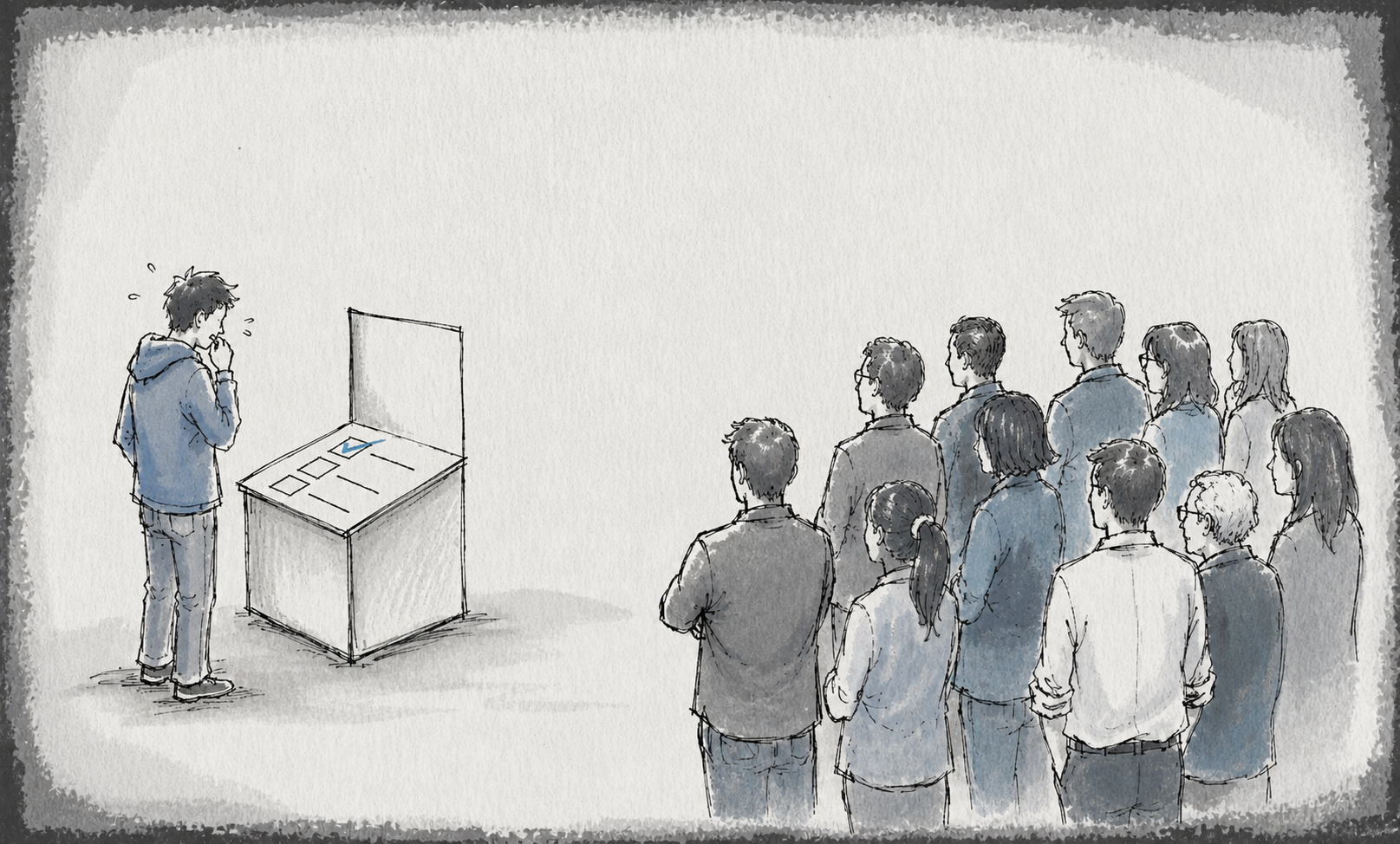
On June 18, a former Cabinet minister and the most popular politician in Britain will ask the voters of a post-industrial Lancashire constituency to make him their MP. The request carries a weight that few by-elections ever have. According to our forecasters, if Andy Burnham wins in Makerfield, he will almost certainly become Britain's next Prime Minister. If he loses, Keir Starmer survives, and the Labour Party faces years more of governing with a leader most people don’t want to be Prime Minister going into the next election. The stakes are personal, political, and, thanks to the fragility of the gilts market and the spectre of a reconfigured tax system, economic.
Burnham enters the race from a position of genuine popularity. As Mayor of Greater Manchester, he has built a reputation as a politician who delivers. But he is giving up the safety of City Hall to contest a seat where Reform won decisively in the May 2026 local elections. His Reform opponent, Robert Kenyon, is a local plumber whose social media history has attracted controversy, including posts perceived as dismissive of women and sympathetic to Russia's annexation of Crimea. A third party, Restore, is also standing and could take a meaningful share of the right-wing vote. The outcome seems uncertain to many.
The Swift Centre has convened its team of professional forecasters to assess what is most likely to happen on June 18, and what follows from it.
Key Takeaways
The Swift Centre forecasters give Andy Burnham a 63% chance of winning the Makerfield by-election on June 18, with estimates ranging from 57% to 70%. The race is competitive, and a Reform upset cannot be ruled out.
If Burnham wins, there is an 81% probability that Britain will have a new Prime Minister before the end of 2026, reflecting his commanding lead over Starmer in polls of Labour members. If he loses, that probability falls to 32%, with no challenger of comparable strength waiting in the wings.
A general election before the end of 2026 is seen as very unlikely in either scenario: 4% if Burnham wins, 1% if he loses. No Labour leader would willingly dissolve a 170-seat majority to face an electorate currently favouring Reform.
Bond markets are already pricing in the risk of a Burnham premiership. If he wins, forecasters expect the peak 30-year gilt yield to reach approximately 5.9% (range: 5.7% to 6.2%) before August 1. A Burnham loss brings a lower median of 5.7%, though the Iran war keeps yields elevated regardless of the result.
The probability of capital gains tax being equalised with income tax rates within one year of the by-election stands at 22% if Burnham wins, and 12% if he loses. Most forecasters are sceptical it could be delivered in such a short timeframe, even if the political will exists.
I. One Man Against the Current
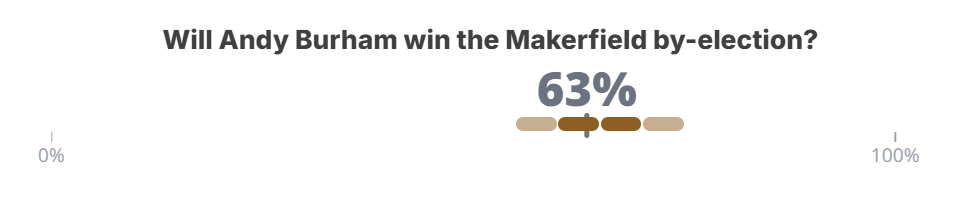
The Swift Centre's forecasters place the probability of a Burnham victory at 63%, with individual estimates ranging from 57% to 70%. This is a clear but not emphatic lead, reflecting a contest that could plausibly go either way.
The core of the Burnham case is personal as much as political. He represented a neighbouring constituency earlier in his career, grew up close to Makerfield, and sent his children to school in the area. Many voters know him, or know of him, in a way that national politicians rarely achieve. His pitch, that a vote for him is a vote to remove Starmer, has a rare coherence for a by-election: an explicit referendum on the sitting Prime Minister, run by the one candidate credibly positioned to replace him.
But the forecasters are careful not to dismiss the countervailing evidence.
"Reform did crush Labour in Makerfield in the May 2026 local elections. It is at least possible that anti-Labour sentiment overweights everything else and delivers a surprise defeat."
On-the-ground reporting has added to the uncertainty.
"Reporters who have used the trick of asking people how their friends and family will vote suggest it could be roughly 50-50 between Burnham and Reform."
The single constituency poll conducted so far placed Burnham three points ahead, a lead within the margin of error. Kenyon's controversies may not cut through in a seat where the Reform wave has been strongest, and where Restore's presence complicates the arithmetic for everyone.
II. The Path to Number 10
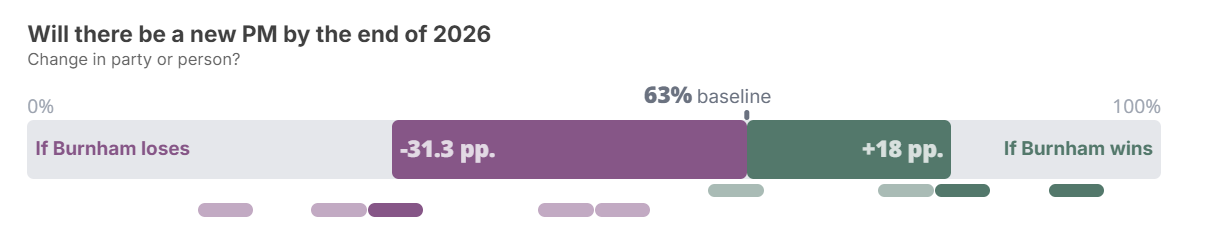
Should Burnham win on June 18, the Swift Centre's forecasters see an 81% probability that Britain will have a new Prime Minister before the end of 2026, with individual estimates ranging from 60% to 90%. The arithmetic of a Labour leadership contest is compelling: Burnham already commands a lead of more than 20 points over Starmer in polls of Labour Party members, and a string of recent surveys has confirmed that the gap is consistent. Starmer, on this reading, would face a contest he is unlikely to win and might not even choose to enter.
"If Burnham wins, he has to go to challenge Starmer. Starmer is so unpopular with the public and MPs will want to salvage some political support."
The principal uncertainty is timing. A Labour leadership contest takes months to run, and the calendar is unforgiving.
"The timing is the one risk. Last time it took three months, and the process can easily drag to four. If it is not rolled out during the summer, there is some small chance it will not be finished by December."
A Burnham loss tells a different story. The probability of a new PM by year-end falls to 32%, now dependent on weaker challengers mounting a campaign that Starmer is well-placed to see off.
"Burnham's loss would mean the removal of the main challenger. Rayner and Streeting are weaker, which is why the by-election scheme was thought of in the first place."
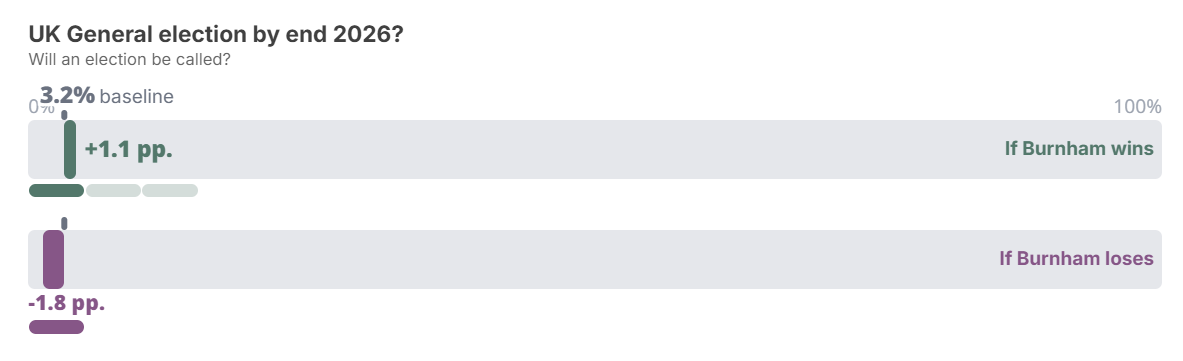
As for a general election: our forecasters put the probability at just 4% even if Burnham wins, and lower still at 1% if he loses. The political logic is unambiguous. Labour is behind in the polls. No new leader, however popular at the outset, would willingly dissolve a 170-seat parliamentary majority to test an electorate that is, by most measures, still moving toward Reform. Burnham has confirmed as much publicly, stating he has no plans to call an early election if he becomes Prime Minister.
III. The Markets Have Already Voted
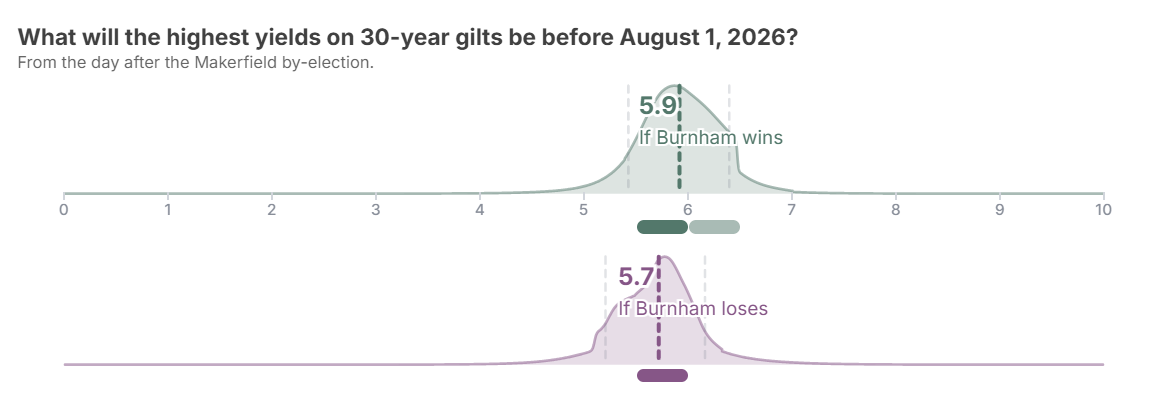
The bond markets have not waited for June 18. The 30-year gilt yield hit 5.85% on May 15, the day Burnham was confirmed as Labour's candidate. It has since eased to around 5.5%, partly on the back of Burnham's pledges to maintain Rachel Reeves' fiscal rules, and partly on tentative optimism about a resolution to the Iran war. But the relief is conditional.
"A Burnham win is widely seen as an inflationary signal."
The concern among gilt investors is not abstract. Burnham has previously said Britain should not be "in hock" to the bond markets, and has spoken of renationalising utilities and establishing a National Care Service.
"The risk is a reaction not unlike what happened when Liz Truss became Prime Minister."
That comparison may be unfair, but markets are pricing it as a non-trivial possibility.
Our forecasters estimate that if Burnham wins, the peak 30-year gilt yield before August 1 will reach approximately 5.9%, with a plausible range of 5.7% to 6.2%. If he loses, the median falls to 5.7%, within a tighter range of 5.6% to 5.8%. But forecasters are clear that the Iran war is an independent pressure on yields that no UK election result will resolve.
"There are shortages of critical industrial materials. The longer the Strait of Hormuz remains closed, the higher inflation goes, independently of what happens in Makerfield."
Even a Burnham loss does not return the gilt market to calmer waters.
IV. The Tax Question
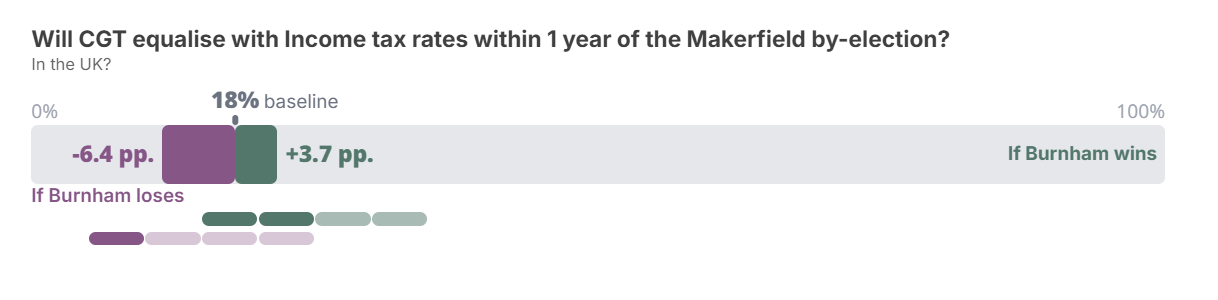
One specific policy proposal has emerged as a test case for the economic direction a Burnham government might take: the equalisation of capital gains tax with income tax rates. The idea has been championed loudest by Wes Streeting, who is positioning himself as a potential Chancellor in a Burnham administration.
Our forecasters put the probability of this happening within one year at 22% if Burnham wins, ranging from 16% to 32%. It falls to 12% if he loses, ranging from 8% to 20%. Scepticism is widespread and well-argued.
"CGT equalisation is a desperate scheme aimed to fool voters. Income tax revenues are more than 20 times those of CGT. The scale required for the average person to feel the difference is completely unattainable without killing the economy."
Even those who consider it possible acknowledge the structural obstacles.
"If Burnham makes Streeting his Chancellor, something like this could happen. But it would seem unlikely that such a large change could be accomplished politically within one year."
Burnham himself has been more cautious, signalling greater interest in land value taxation than in CGT reform. The CGT question is best understood as one element in a broader picture of fiscal uncertainty that any Burnham premiership would carry into office from day one.
All of this, the question of who leads Britain, the direction of fiscal and tax policy, the trajectory of the gilt market, now rests on the outcome in a single Lancashire constituency on a single day in June. By-elections do not usually have such potential for impact and disruption.This one could shape the UK for the next decade, all in the hands of the Makerfield voters